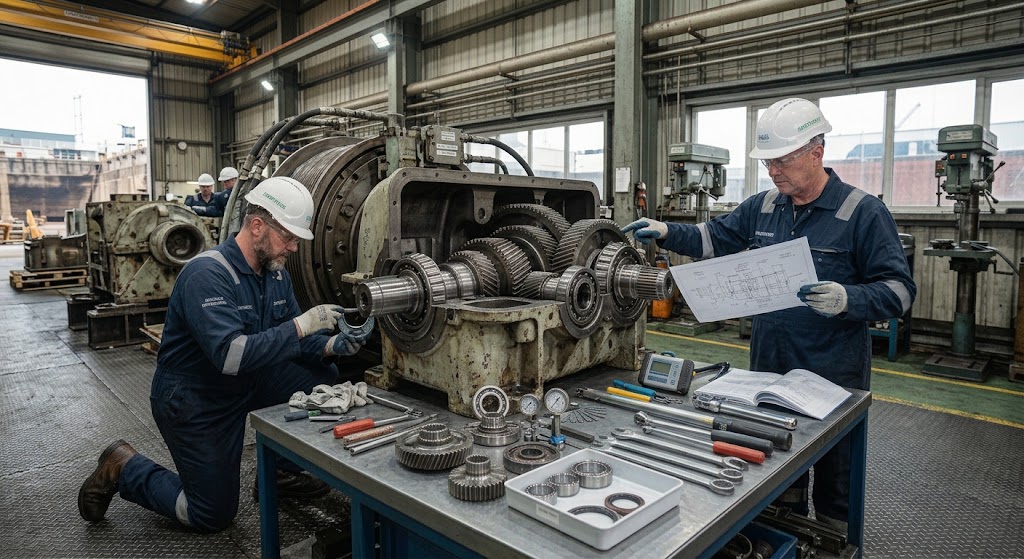
Why Crane Gearbox Reliability Matters
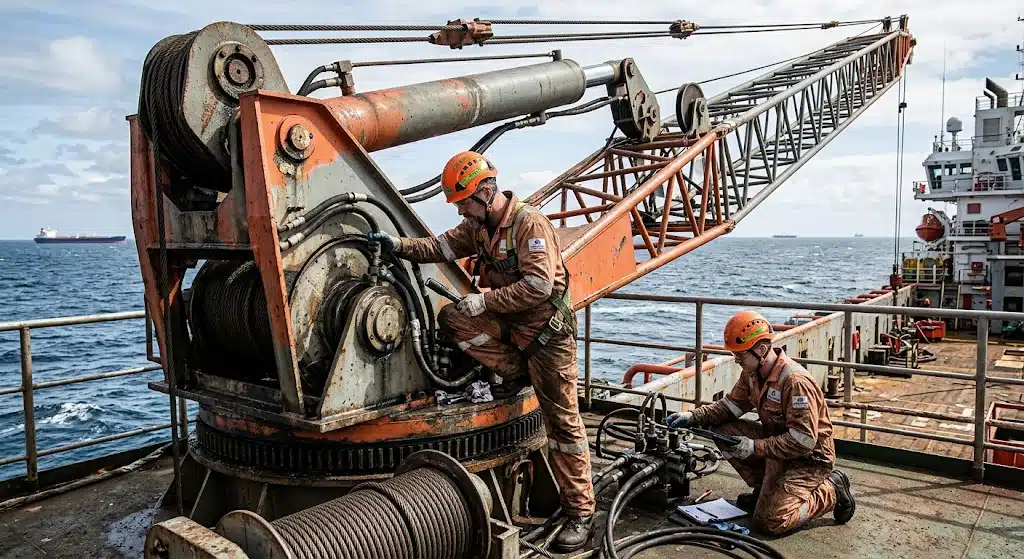
Marine and offshore operations continue to demand higher equipment availability, faster turnaround, and tighter control of maintenance costs. Therefore, reliable crane systems have become essential for safe lifting and material-handling operations. At the heart of many crane systems, the gearbox transfers power and controls torque, speed, and movement. When it develops a fault, the entire crane can become unavailable.
Professional Crane Gearbox Repair provides a structured way to address gearbox wear, damage, abnormal noise, vibration, lubrication problems, and performance loss. Instead of waiting for a catastrophic failure, operators can identify developing problems and restore critical components during planned maintenance.
For ship owners, ship management companies, offshore operators, shipyards, construction companies, mining contractors, and industrial facilities, gearbox reliability directly affects operational continuity. Moreover, an effective repair program can help extend equipment service life and reduce unnecessary replacement costs.
This article explains common crane gearbox problems, the repair and overhaul process, preventive maintenance requirements, and how PT. FIITEK INDONESIA can support marine and industrial crane equipment.
What Is Crane Gearbox Repair?
Crane gearbox repair is a technical service that restores the mechanical condition and operating performance of a crane transmission system.
A crane gearbox transfers power from an electric or hydraulic drive to the crane mechanism. Depending on the crane design, the gearbox may control hoisting, slewing, traveling, luffing, or other movements.
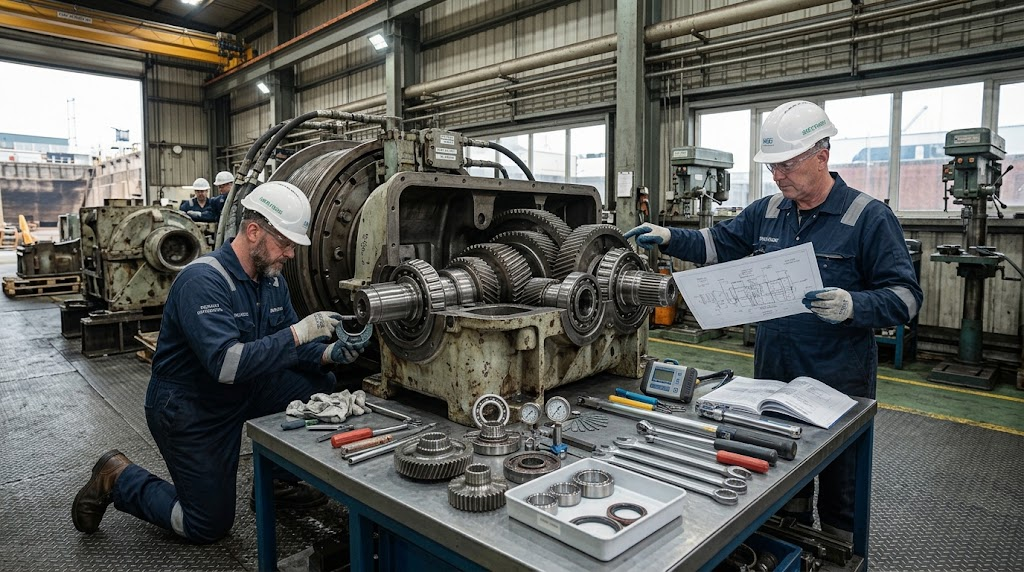
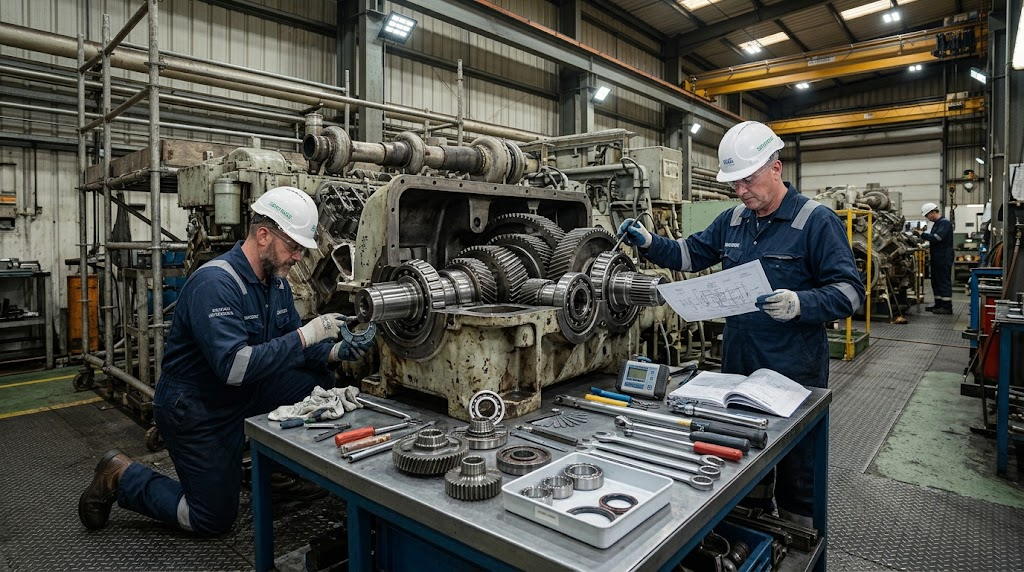
During repair, technicians inspect the gearbox and its internal components. They then determine whether components require cleaning, adjustment, reconditioning, repair, or replacement.
Components Commonly Inspected
A professional gearbox inspection can include:
- Gears and gear teeth
- Shafts
- Bearings
- Bushings
- Oil seals
- Mechanical seals
- Couplings
- Gearbox housing
- Lubrication system
- Breathers and filters
- Fasteners
- Output and input assemblies
Why Gearbox Inspection Requires Precision
A gearbox contains components that operate with controlled clearances and alignment.
Even a small dimensional deviation can affect gear contact, bearing loading, vibration, and operating temperature.
Therefore, technicians should use appropriate measurement and inspection methods rather than relying only on visual checks.
Common Crane Gearbox Problems
Crane gearboxes operate under variable loads and frequent start-stop cycles. Consequently, wear can develop gradually before operators notice a serious performance problem.
Gear Tooth Wear and Damage
Gear teeth experience repeated contact forces during operation.
Poor lubrication, excessive loading, misalignment, contamination, and component fatigue can accelerate wear.
Technicians should inspect tooth surfaces for pitting, scoring, cracking, abnormal wear patterns, and other damage.
Bearing Failure
Bearings support rotating shafts and maintain proper alignment.
However, contamination, insufficient lubrication, excessive loading, or misalignment can shorten bearing life.
Common warning signs include abnormal noise, increased vibration, and elevated operating temperature.
Shaft Wear or Misalignment
Gearbox shafts must maintain correct alignment with connected components.
Misalignment can increase bearing loads and affect gear contact.
Therefore, shaft condition and alignment should form part of a comprehensive Crane Gearbox Repair assessment.
Oil Leakage
Oil seals and gaskets can deteriorate over time.
As a result, gearbox oil may leak through shafts, covers, inspection points, or damaged sealing surfaces.
Low oil levels can then increase friction and heat generation.
Overheating
Excessive gearbox temperature may indicate lubrication problems, overload, bearing damage, incorrect oil levels, or internal friction.
Operators should investigate the cause rather than simply adding more lubricant.
Abnormal Noise and Vibration
Changes in gearbox sound can provide valuable early warning.
Grinding, whining, knocking, or unusual mechanical noise may indicate gear or bearing problems.
Similarly, increasing vibration can point to imbalance, misalignment, looseness, or internal wear.
Crane Gearbox Repair and Overhaul Process
A reliable repair program requires more than replacing a visibly damaged component.
PT. FIITEK INDONESIA can approach gearbox service through a structured inspection, repair, reassembly, and testing process.
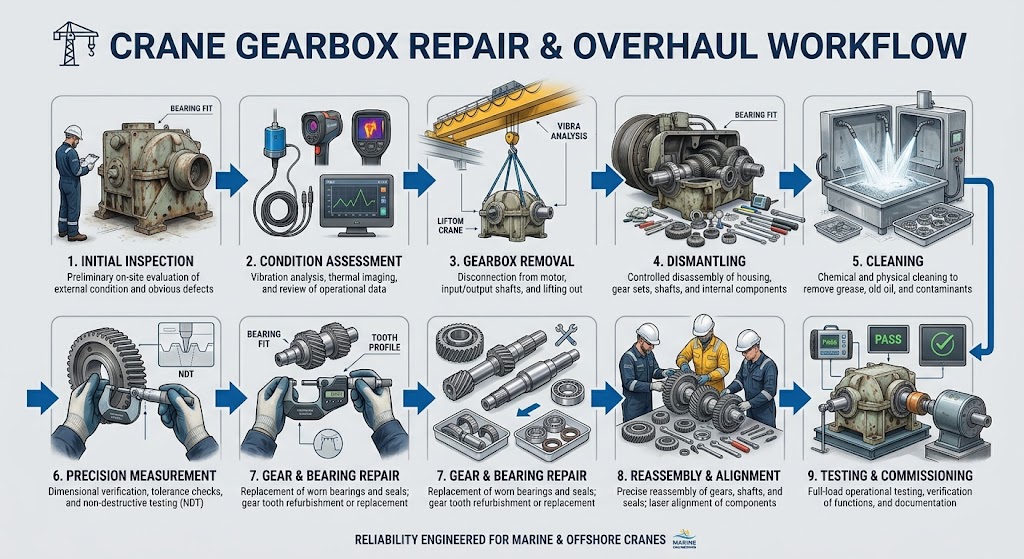
1. Initial Inspection and Condition Assessment
The process begins with an assessment of the gearbox and its operating condition.
Technicians review available maintenance records and discuss reported symptoms with the equipment operator.
The inspection may cover:
- Operating noise
- Vibration
- Oil leakage
- Oil condition
- Operating temperature
- Gearbox housing
- Shaft condition
- Coupling condition
- Mounting condition
- Previous repair history
Identifying the Root Cause
A successful repair should address the reason for failure.
For example, repeated bearing damage may result from poor alignment rather than bearing quality alone.
Likewise, abnormal gear wear may result from lubrication problems or excessive loading.
Therefore, root-cause evaluation can help prevent recurring failures.
2. Gearbox Removal and Dismantling
If the gearbox requires workshop-level repair, technicians carefully remove and dismantle the unit.
Each component should receive appropriate identification and documentation.
This approach supports accurate inspection and helps maintain component traceability throughout the repair.
3. Cleaning and Internal Inspection
After dismantling, technicians clean the internal components.
Oil deposits, metal particles, dirt, and contamination can hide defects.
Once clean, technicians inspect gears, shafts, bearings, seals, housings, and other components.
4. Precision Measurement
Measurement provides objective information about component condition.
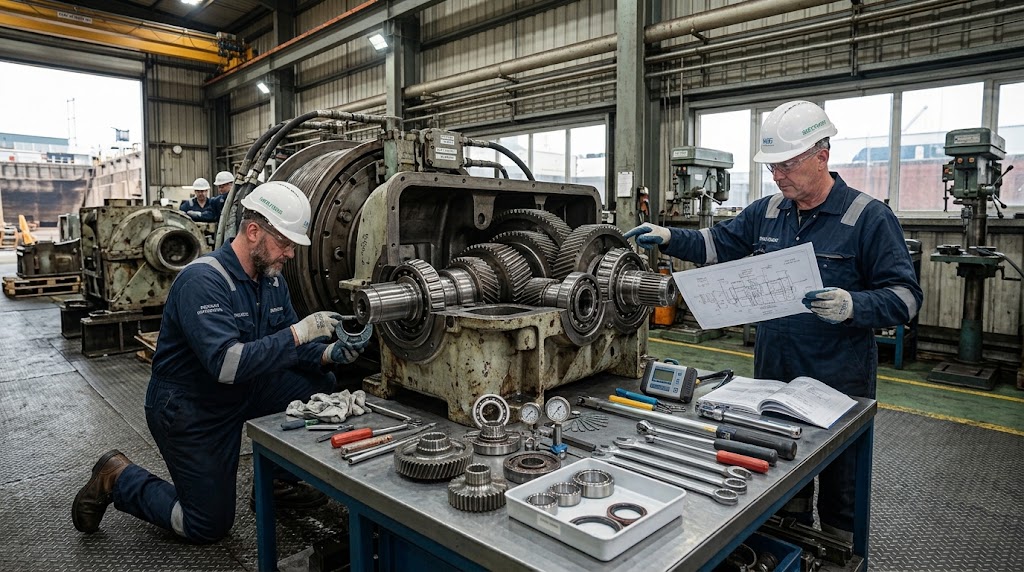
Technicians may check:
- Shaft dimensions
- Bearing clearances
- Gear backlash
- Gear tooth condition
- Housing condition
- Shaft runout
- Bearing seating surfaces
- Coupling alignment
Repair, Recondition, or Replace?
Not every worn component requires complete replacement.
Technicians evaluate each part according to its actual condition and applicable technical requirements.
Suitable components may undergo reconditioning. Severely damaged components may require replacement.
This approach can help balance reliability and maintenance cost.
5. Gear and Shaft Repair
Gear damage requires careful technical evaluation.
Depending on the condition, technicians may recommend gear replacement, reconditioning, or other appropriate repair measures.
Similarly, shafts may require inspection for wear, runout, surface damage, or dimensional changes.
The repair method should reflect the component’s condition and equipment requirements.
6. Bearing and Seal Replacement
Worn bearings can affect gearbox alignment and operating efficiency.
Therefore, technicians should inspect bearing surfaces, fits, lubrication paths, and related components.
Technicians may also replace oil seals, gaskets, and other sealing elements during the repair.
Replacing these relatively small components can help prevent future leakage.
7. Lubrication System Inspection
Gearbox lubrication plays a critical role in reducing friction and controlling component temperature.
Technicians should check lubricant condition, oil levels, contamination, filters, breathers, and lubrication passages.
Contamination Control
Metal particles or foreign contaminants can accelerate gear and bearing wear.
Therefore, maintaining clean lubricant is an important part of gearbox reliability.
Operators should also use lubricant specifications appropriate for the gearbox design and operating conditions.
8. Reassembly and Alignment
After completing repairs, technicians carefully reassemble the gearbox.
Correct bearing installation, gear positioning, clearances, seals, fastener torque, and lubrication are essential.
Moreover, technicians should verify alignment between the gearbox and connected crane drive components.
9. Testing and Commissioning
Testing verifies the gearbox after repair.
Depending on the application, testing may include:
- No-load operation
- Directional operation
- Speed verification
- Noise monitoring
- Vibration monitoring
- Temperature monitoring
- Lubrication checks
- Leakage inspection
- Functional testing under appropriate operating conditions
The objective is to confirm stable gearbox operation before returning the crane to service.
Benefits of Professional Crane Gearbox Repair
Professional gearbox repair provides several operational advantages.
Improved Crane Reliability
A properly inspected gearbox can provide more predictable performance.
Therefore, operators can reduce the risk associated with unexpected mechanical failure.
Extended Equipment Service Life
Reconditioning suitable components can extend the useful life of an existing gearbox.
This can be particularly valuable when the complete crane remains structurally and operationally suitable.
Reduced Unplanned Downtime
Planned repair allows operators to coordinate maintenance with vessel schedules, offshore campaigns, construction activities, or production requirements.
As a result, maintenance teams can better control operational interruptions.
Improved Maintenance Cost Control
Replacing an entire gearbox may not always be necessary.
A detailed inspection can identify which components actually require attention.
Consequently, operators can make maintenance decisions based on equipment condition rather than assumptions.
Improved Operational Safety
Crane systems handle significant loads.
Therefore, gearbox condition contributes to controlled and predictable crane movement.
Regular inspection and maintenance can support a broader equipment safety strategy.
Crane Gearbox Applications Across Industries
Gearboxes serve different crane configurations across marine and industrial environments.
Marine Cranes
Marine cranes operate on vessels, workboats, cargo ships, and other marine assets.
They may support cargo handling, stores handling, equipment transfer, and general deck operations.
Because marine cranes face vibration and saltwater exposure, gearbox inspection remains important.
Offshore Cranes
Offshore cranes support demanding lifting operations in challenging environments.
They may operate under variable loads and frequent duty cycles.
Therefore, preventive gearbox maintenance can help operators maintain equipment availability.
Shipyard Cranes
Shipyards depend on cranes for heavy material handling and fabrication activities.
A gearbox failure can interrupt production workflows.
Consequently, scheduled inspection can help maintenance teams identify developing problems before they affect operations.
Construction and Mining Cranes
Construction and mining operations often expose lifting equipment to heavy loads, dust, vibration, and demanding duty cycles.
These conditions can accelerate mechanical wear.
Therefore, crane gearbox maintenance should form part of the wider equipment reliability program.
Why Choose PT. FIITEK INDONESIA?
Selecting an experienced technical service partner is important when dealing with critical crane equipment.
PT. FIITEK INDONESIA provides engineering-focused repair and maintenance support for marine, offshore, construction, and industrial applications.
Condition-Based Service Approach
Every gearbox has a different operating history.
Therefore, PT. FIITEK INDONESIA focuses on the actual condition of the equipment when defining repair requirements.
Mechanical Expertise
Gearboxes require careful attention to gears, bearings, shafts, seals, alignment, lubrication, and assembly.
A systematic approach helps ensure that these elements receive appropriate inspection.
Comprehensive Repair Support
The service scope can include inspection, dismantling, cleaning, component evaluation, repair, replacement, reassembly, alignment, and testing.
This creates a more integrated approach to gearbox maintenance.
Support for Critical Equipment
Marine and offshore operations often operate under strict schedules.
Therefore, technical service must consider both equipment requirements and operational priorities.
PT. FIITEK INDONESIA can support planned maintenance activities with a structured and professional approach.
Flexible Project Scope
Not every gearbox requires a complete overhaul.
Depending on inspection results, the service may focus on specific components or involve a comprehensive repair and overhaul.
This flexibility allows the maintenance scope to reflect actual equipment condition.
Preventive Maintenance After Crane Gearbox Repair
Repair should not represent the final step in gearbox reliability management.
Instead, operators should establish preventive maintenance after returning the crane to operation.
Monitor Temperature and Vibration
Temperature and vibration can provide early indications of developing mechanical problems.
Therefore, operators should record baseline operating conditions after repair.
Changes from the baseline may warrant further investigation.
Maintain Correct Lubrication
Proper lubrication protects gears and bearings from excessive friction.
Maintenance teams should monitor oil levels and condition.
Furthermore, they should investigate contamination, discoloration, metal particles, or unusual lubricant consumption.
Inspect Seals and Leakage Points
Small oil leaks can become larger problems.
Therefore, maintenance teams should inspect seals, covers, shafts, and other potential leakage points during routine inspections.
Monitor Crane Operating Behavior
Operators should report changes in:
- Crane movement
- Gearbox noise
- Vibration
- Hoisting speed
- Slewing performance
- Operating temperature
- Brake response
Early reporting allows maintenance teams to investigate potential problems before they become major failures.
When Should You Schedule Crane Gearbox Repair?
The timing of gearbox repair depends on operating hours, load cycles, environmental conditions, maintenance history, and equipment design.
However, several symptoms should trigger a technical inspection.
These include:
- Increasing vibration
- Abnormal gearbox noise
- Oil leakage
- Excessive temperature
- Reduced crane performance
- Irregular movement
- Repeated bearing failures
- Visible gear damage
- Lubricant contamination
- Unusual metal particles in gearbox oil
- Recurring seal failures
When these symptoms appear, operators should investigate promptly.
Waiting for complete gearbox failure can increase repair complexity and operational downtime.
Building a Long-Term Crane Reliability Strategy
Modern industrial maintenance increasingly focuses on lifecycle equipment performance.
Therefore, operators should combine routine inspections with preventive maintenance and planned repair.
Condition monitoring can also provide useful information between major overhaul periods.
For example, vibration trends can reveal changes in gearbox condition. Oil inspection can identify contamination or abnormal wear. Temperature trends can highlight lubrication or bearing issues.
Moreover, maintenance teams can use repair findings to improve future maintenance planning.
If the same component repeatedly fails, the team should investigate the underlying operating conditions.
Potential causes may include overload, misalignment, contamination, lubrication problems, installation errors, or unsuitable operating practices.
This approach transforms repair data into a long-term reliability strategy.
Conclusion: Protect Crane Performance with Professional Gearbox Service
Crane gearboxes play a critical role in controlled lifting and material-handling operations. When gears, bearings, shafts, seals, or lubrication systems deteriorate, crane performance can decline and operational risks can increase.
Professional Crane Gearbox Repair provides a structured solution for inspecting, repairing, reconditioning, and testing gearbox systems.
However, effective maintenance extends beyond repairing damaged components. Regular inspection, lubrication management, vibration monitoring, temperature monitoring, alignment checks, and preventive maintenance all contribute to long-term gearbox reliability.
For ship owners, vessel operators, offshore companies, shipyards, marine engineers, construction contractors, mining companies, and industrial procurement teams, PT. FIITEK INDONESIA provides engineering-focused support for crane gearbox inspection, repair, overhaul, and maintenance.
STAY IN THE LOOP
Subscribe to our free newsletter.
Leave A Comment

Marine and offshore lifting operations are becoming more demanding. Vessel owners, offshore operators, shipyards, and industrial companies need crane systems that can perform safely under heavy loads and harsh conditions. As a result, marine crane overhaul services have become an important part of equipment reliability and lifecycle management. Marine cranes operate in challenging environments. Saltwater

Marine and offshore operations are demanding higher equipment reliability while facing tighter maintenance schedules and rising operational costs. In this environment, Winch Repair and Overhaul plays an important role in keeping critical lifting, mooring, towing, and deck operations running safely. A winch may operate continuously under heavy loads, vibration, moisture, corrosion, and changing environmental conditions.
-
Marine and offshore operations face increasing pressure to improve equipment reliability, reduce downtime, and control maintenance costs. At the same time, vessels and industrial equipment operate in demanding environments where mechanical components face heavy loads, vibration, corrosion, heat, and continuous operation. In this environment, Marine Machinery Overhaul plays an important role in maintaining equipment performance
-
Modern marine and offshore operations depend on electrical systems more than ever. From generators and switchboards to motors, control panels, navigation equipment, cranes, and emergency systems, electrical power keeps critical assets operating. However, harsh offshore conditions can accelerate electrical deterioration. Therefore, professional Offshore Electrical Maintenance has become essential for companies that want to protect safety,