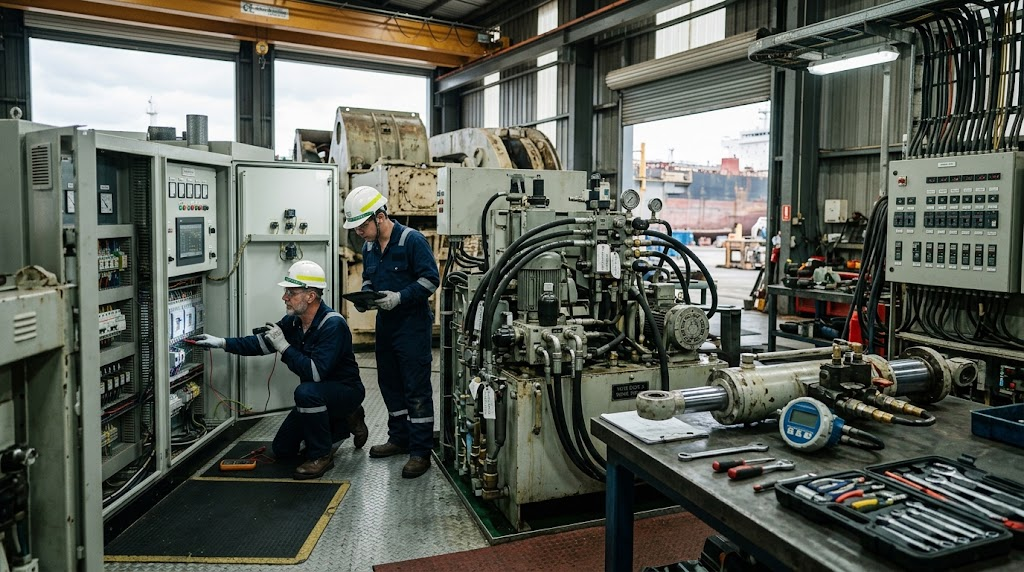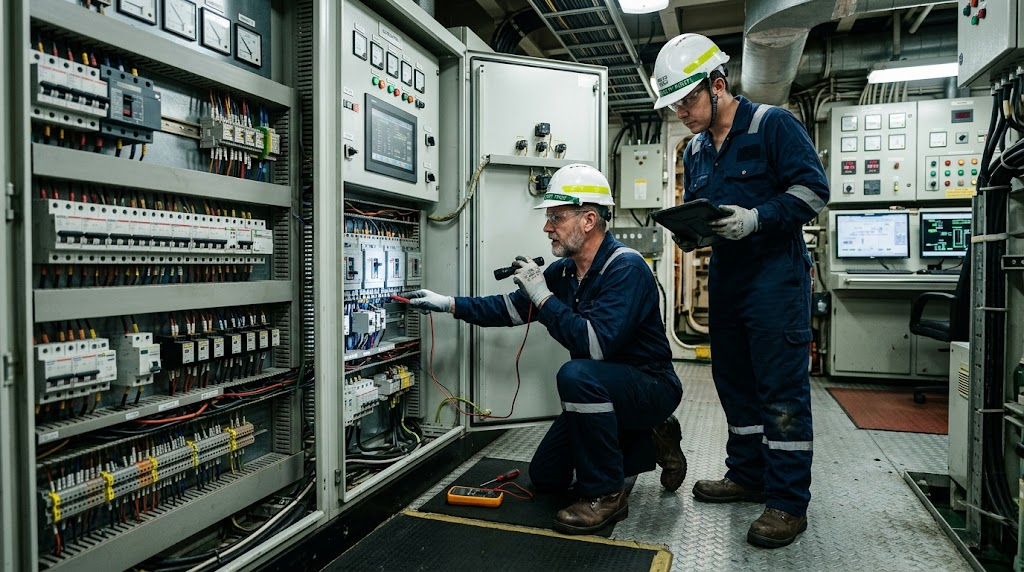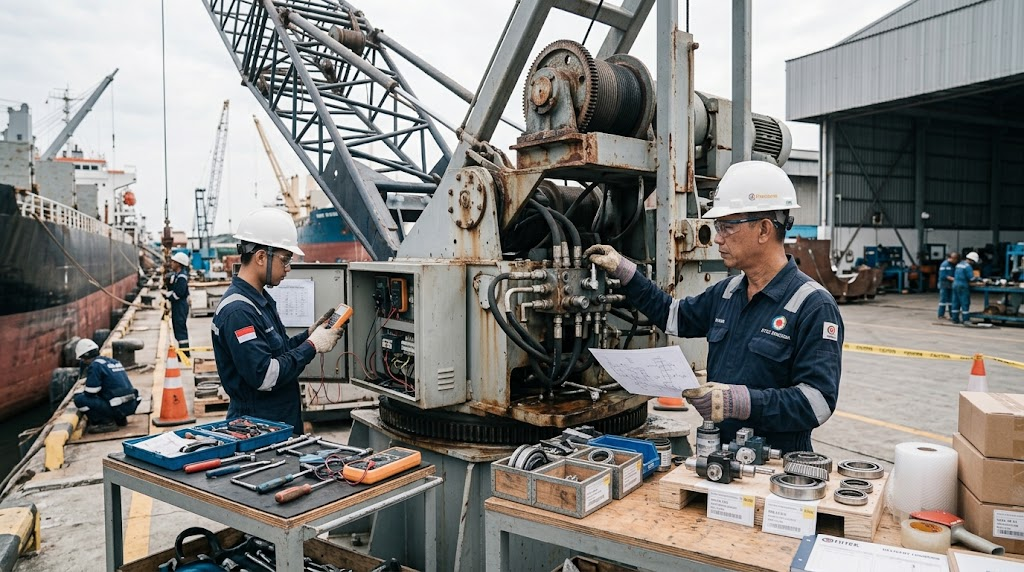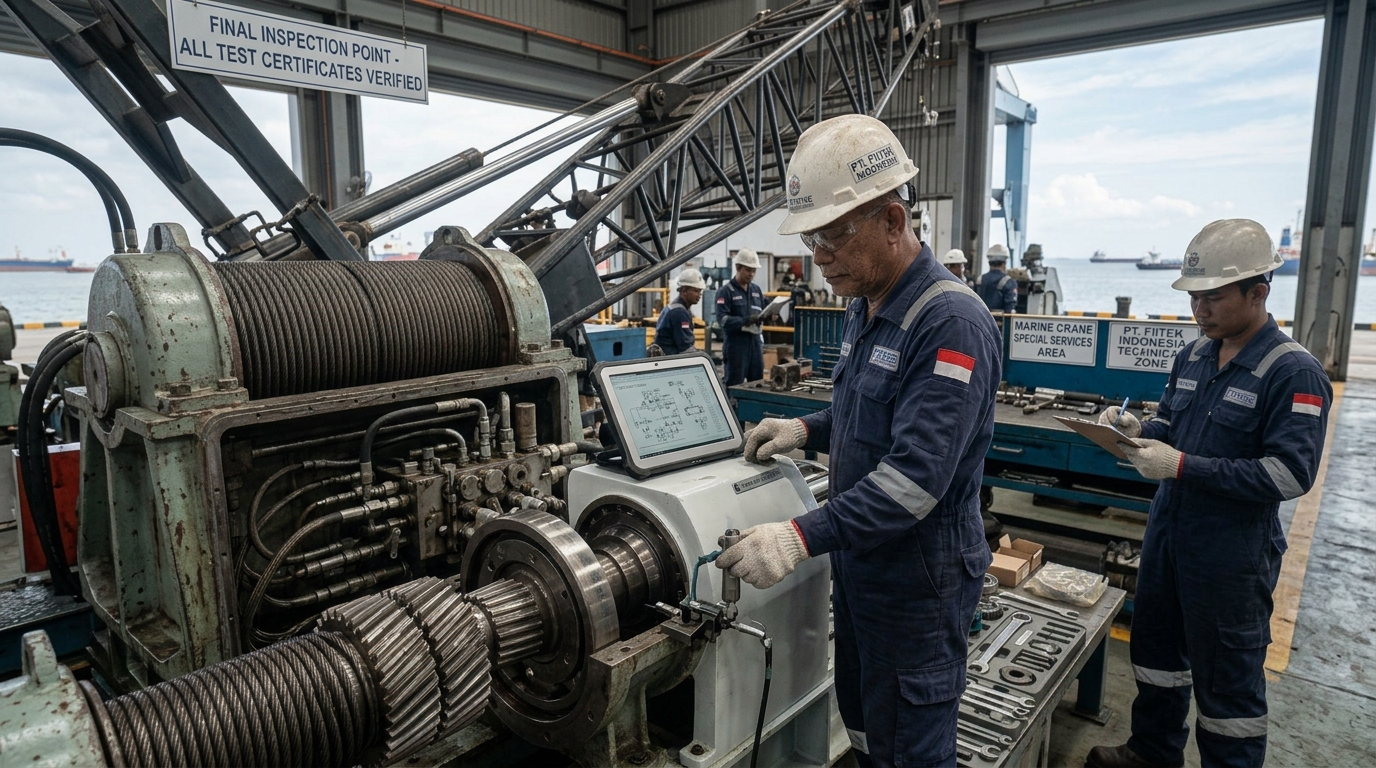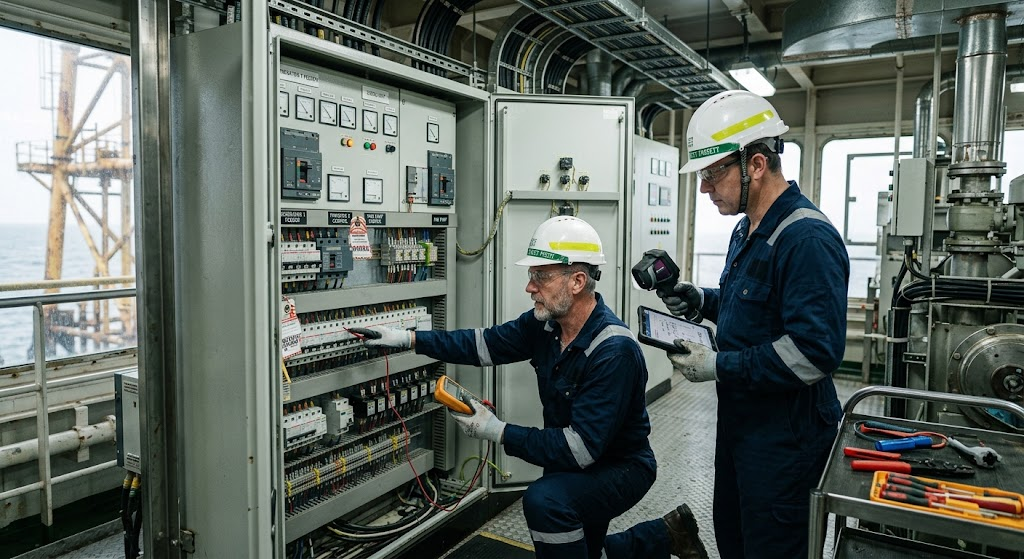
Modern marine and offshore operations depend on electrical systems more than ever. From generators and switchboards to motors, control panels, navigation equipment, cranes, and emergency systems, electrical power keeps critical assets operating. However, harsh offshore conditions can accelerate electrical deterioration. Therefore, professional Offshore Electrical Maintenance has become essential for companies that want to protect safety, reliability, and operational uptime.
Saltwater, humidity, vibration, heat, corrosion, electrical loading, and continuous operation can gradually weaken electrical components. As a result, a small defect can develop into equipment downtime or a serious operational disruption.
For ship owners, vessel operators, shipyards, offshore companies, marine engineers, procurement teams, construction companies, and mining operators, proactive electrical maintenance offers a practical way to reduce these risks.
PT. FIITEK INDONESIA provides professional electrical inspection, troubleshooting, repair, testing, and maintenance solutions for demanding marine, offshore, construction, and industrial environments.
This guide explains the importance of offshore electrical maintenance, common electrical problems, maintenance procedures, preventive strategies, technology, regulatory considerations, and the benefits of working with an experienced technical service partner.
Why Offshore Electrical Maintenance Is Critical
Electrical systems support almost every major operation onboard vessels and offshore facilities. Consequently, electrical reliability directly affects productivity and safety.
A vessel may rely on electrical power for propulsion support systems, navigation, communication, lighting, pumps, ventilation, automation, and emergency equipment. Similarly, offshore facilities depend on electrical distribution networks for machinery, control systems, production equipment, and safety systems.
Therefore, electrical maintenance should form part of a broader asset reliability strategy.
The Cost of Electrical Failure
Unexpected electrical failures can create significant operational consequences.
For example, a damaged cable termination may cause overheating. Likewise, a failing motor can interrupt a pump or hydraulic system. A switchboard fault can potentially affect several connected systems simultaneously.
Common consequences include:
- Unplanned equipment downtime
- Production interruptions
- Vessel delays
- Reduced asset availability
- Emergency repair expenses
- Equipment damage
- Safety risks
- Project schedule disruption
- Increased maintenance costs
Moreover, repeated electrical failures can indicate an underlying condition that requires professional investigation.
Offshore Environments Create Additional Challenges
Offshore electrical equipment faces environmental conditions that can accelerate deterioration.
High humidity can affect insulation and electrical connections. Meanwhile, saltwater exposure can increase corrosion risk. Vibration can also loosen connections and stress cables.
Temperature changes create additional challenges. Furthermore, equipment often operates continuously under demanding loads.
Therefore, offshore electrical maintenance requires a systematic approach rather than occasional visual checks.
Common Electrical Problems in Marine and Offshore Equipment
Understanding common failure modes helps maintenance teams develop more effective inspection programs.
Cable and Insulation Deterioration
Cables are essential to electrical distribution and control systems. However, insulation can deteriorate because of heat, moisture, mechanical movement, chemicals, aging, and physical damage.
Technicians should inspect:
- Cable insulation
- Cable glands
- Cable trays
- Junction boxes
- Connectors
- Terminations
- Grounding connections
- Signs of overheating
- Corrosion around connections
Preventing Cable-Related Failures
Regular inspection can identify damaged insulation before it creates a larger electrical problem.
Where appropriate, electrical testing can provide additional information about insulation condition and system integrity.
Motor and Generator Problems
Motors and generators often operate for extended periods. Consequently, they require consistent monitoring and maintenance.
Typical problems include overheating, insulation deterioration, electrical imbalance, contamination, vibration, connection problems, and mechanical wear.
A professional maintenance program may include:
- Visual inspection
- Electrical measurements
- Insulation testing
- Connection inspection
- Temperature monitoring
- Vibration assessment
- Cleaning
- Functional testing
- Why Motor Condition Matters
A motor problem can affect an entire process.
For example, a motor may drive a pump, fan, winch, crane, or hydraulic power unit. Therefore, early diagnosis can help prevent secondary equipment problems and operational downtime.
Switchboard and Distribution System Problems
Switchboards manage and distribute electrical power throughout a vessel or facility.
Loose connections, overloaded circuits, corrosion, contamination, damaged breakers, and component aging can affect reliability.
Thermal inspection can help identify abnormal heat patterns. In addition, electrical testing can help technicians evaluate system condition.
Control Panel and Automation Issues
Modern offshore equipment increasingly depends on control and automation systems.
PLCs, sensors, control panels, relays, communication systems, and monitoring devices can influence critical equipment performance.
As a result, electrical troubleshooting often requires an understanding of both power systems and control systems.
Offshore Electrical Maintenance Process
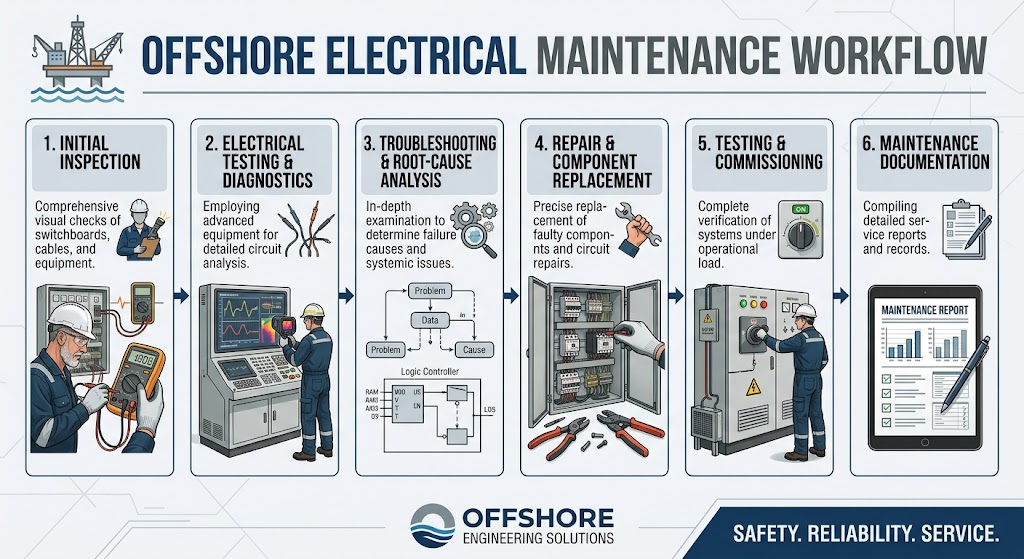
A structured maintenance process helps technicians identify problems efficiently and restore equipment safely.
PT. FIITEK INDONESIA can adapt the service scope to the equipment type, operational requirements, asset condition, and project environment.
1. Initial Inspection
The process starts with a detailed equipment assessment.
Technicians inspect accessible electrical components and look for visible defects, overheating, corrosion, damaged wiring, loose connections, abnormal conditions, and other warning signs.
The inspection may cover:
- Electrical distribution panels
- Switchboards
- Generators
- Motors
- Control panels
- Cables
- Electrical machinery
- Lighting systems
- Emergency electrical systems
- Deck machinery
- Instrumentation
This stage establishes an initial understanding of equipment condition.
2. Electrical Testing and Diagnostics
Visual inspection cannot reveal every electrical problem.
Therefore, technicians may perform appropriate diagnostic tests based on equipment specifications and safety requirements.
These may include:
- Voltage measurements
- Current measurements
- Continuity testing
- Insulation resistance testing
- Grounding verification
- Phase sequence checks
- Thermal imaging
- Motor testing
- Generator testing
- Circuit verification
- Control-system diagnostics
The results help technicians determine the source and severity of an electrical problem.
3. Troubleshooting and Root-Cause Analysis
Effective troubleshooting goes beyond identifying a failed component.
Technicians should also determine why the failure occurred.
For example, repeated motor overheating may result from excessive loading, poor ventilation, electrical imbalance, mechanical resistance, or insulation deterioration.
Therefore, root-cause analysis can help prevent recurring failures.
Why Root-Cause Analysis Saves Money
Replacing the same component repeatedly increases maintenance costs.
However, identifying the underlying cause can help eliminate recurring problems. Consequently, operators can improve reliability while reducing unnecessary repair cycles.
4. Repair and Component Replacement
After diagnosis, technicians determine the appropriate corrective action.
Depending on equipment condition, the work may include:
- Cable repair
- Electrical connection repair
- Component replacement
- Control panel repair
- Motor servicing
- Generator servicing
- Sensor replacement
- Terminal repair
- Electrical cleaning
- Wiring correction
- System restoration
The objective is to return the equipment to safe and reliable operating condition.
5. Testing and Commissioning
Repair work does not end when the component has been replaced.
Technicians should verify system performance after maintenance.
Depending on the equipment, commissioning may involve functional checks, electrical measurements, operational testing, protection verification, and system monitoring.
Therefore, post-repair testing provides an important final quality-control step.
6. Maintenance Documentation
Accurate documentation supports long-term asset management.
A professional service report may include:
- Equipment identification
- Inspection findings
- Test results
- Fault descriptions
- Corrective actions
- Replaced components
- Recommendations
- Follow-up requirements
As a result, engineering and procurement teams gain useful information for future maintenance planning.
Preventive Offshore Electrical Maintenance
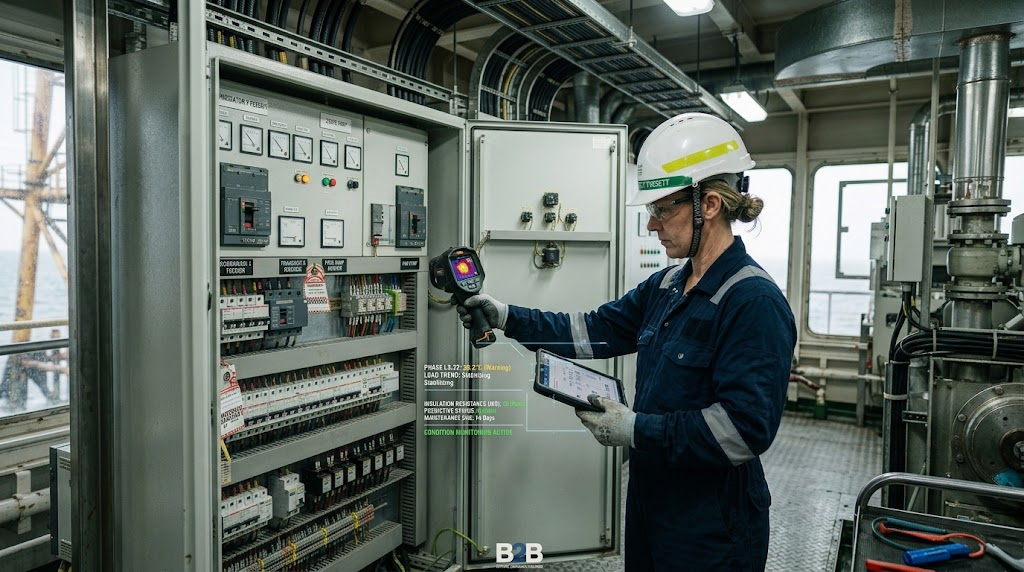
Preventive maintenance focuses on identifying potential failures before they disrupt operations.
Instead of waiting for a component to fail, operators schedule inspections and testing according to equipment condition, operating hours, manufacturer recommendations, and applicable requirements.
Key Preventive Maintenance Activities
A preventive program may include:
- Routine visual inspections
- Electrical testing
- Thermal inspections
- Cable and termination checks
- Cleaning
- Connection tightening
- Insulation assessment
- Motor condition checks
- Generator inspections
- Control panel checks
- Grounding verification
- Functional testing
However, the exact maintenance interval should depend on the specific equipment and operating environment.
Condition-Based Maintenance
Condition-based maintenance provides another approach.
Instead of relying exclusively on fixed maintenance intervals, engineers monitor equipment condition and intervene when data indicates deterioration.
For example, increasing temperature, vibration, current imbalance, or other abnormal trends can indicate a developing problem.
Therefore, condition-based maintenance can help organizations focus resources on equipment that actually requires attention.
Technology in Offshore Electrical Maintenance
Technology is changing how maintenance teams inspect and manage electrical assets.
Thermal Imaging
Thermal cameras can identify abnormal temperature patterns.
Hot connections, overloaded circuits, and deteriorating electrical components may produce unusual thermal signatures.
Consequently, thermal inspection can complement conventional electrical testing.
Digital Maintenance Records
Digital records allow teams to track equipment history more efficiently.
Engineers can compare previous inspection results with current findings. Furthermore, maintenance managers can use historical data to identify recurring issues.
Predictive Maintenance
Predictive maintenance uses equipment data to identify potential problems before failure occurs.
Sensors and monitoring systems can provide information about temperature, vibration, current, voltage, and other operating parameters.
However, technology works best when experienced engineers interpret the data correctly.
Therefore, successful predictive maintenance combines reliable information with practical technical expertise.
Regulatory and Safety Considerations
Marine and offshore electrical maintenance must consider applicable technical and safety requirements.
International maritime operations operate within frameworks established by organizations such as the International Maritime Organization (IMO). Classification societies, flag administrations, equipment manufacturers, project specifications, and local requirements may also apply.
Therefore, maintenance teams should identify the requirements relevant to each vessel, facility, and equipment category.
Electrical Safety
A professional maintenance program should consider:
- Safe electrical isolation
- Grounding and bonding
- Equipment protection
- Emergency power systems
- Cable integrity
- Electrical enclosure condition
- Hazardous-area requirements where applicable
- Equipment documentation
- Inspection records
- Testing procedures
Requirements can vary significantly between vessels, offshore facilities, and industrial sites.
Consequently, companies should verify the applicable requirements before undertaking maintenance work.
Benefits of Professional Offshore Electrical Maintenance
Professional maintenance provides more than equipment repair.
It can contribute to broader operational and commercial objectives.
Improved Equipment Reliability
Regular inspection helps identify developing problems.
Therefore, operators can address defects before they create major disruptions.
Reduced Unplanned Downtime
Unexpected failures can affect vessels, projects, production, and delivery schedules.
Preventive maintenance can reduce the likelihood of sudden equipment failure. As a result, operators gain greater control over maintenance planning.
Improved Safety
Electrical defects can create overheating, short circuits, equipment malfunction, and other safety concerns.
Professional inspection and testing help identify these conditions early.
Better Maintenance Planning
Reliable inspection records help engineering teams plan future maintenance.
Furthermore, historical information can help procurement teams prepare spare-part requirements and service budgets.
Longer Equipment Service Life
Proper maintenance can help preserve electrical components and connected machinery.
However, maintenance cannot eliminate natural equipment aging. Instead, it helps organizations manage deterioration more effectively.
Why Choose PT. FIITEK INDONESIA?
PT. FIITEK INDONESIA understands the demanding requirements of marine, offshore, construction, and industrial environments.
Integrated Technical Approach
Electrical systems often interact with mechanical, hydraulic, automation, and deck machinery systems.
Therefore, technicians need to understand the wider equipment environment.
PT. FIITEK INDONESIA approaches technical problems with this integrated perspective.
Practical Field Service
Offshore and marine equipment requires practical field experience.
Technical teams must work efficiently while respecting operational constraints, safety procedures, and project schedules.
Comprehensive Maintenance Support
PT. FIITEK INDONESIA can support customers through multiple stages of electrical service, including:
- Inspection
- Testing
- Troubleshooting
- Electrical repair
- Component replacement
- Preventive maintenance
- System verification
- Technical reporting
Consequently, customers can address multiple electrical requirements through a coordinated service approach.
Support Across Multiple Industries
The service approach can support electrical requirements across:
- Marine vessels
- Offshore facilities
- Shipyards
- Construction projects
- Mining operations
- Industrial facilities
- Offshore support vessels
- Cranes and winches
- Hydraulic equipment
- Electrical control systems
This cross-industry experience provides valuable perspective when dealing with complex technical environments.
When Should You Schedule Offshore Electrical Maintenance?
The best maintenance schedule depends on equipment type, operating conditions, manufacturer recommendations, usage, environmental exposure, and applicable technical requirements.
However, certain warning signs should prompt an immediate inspection.
Look for:
- Repeated circuit trips
- Unusual equipment temperature
- Burning odors
- Visible cable damage
- Corroded terminals
- Flickering lights
- Unexpected alarms
- Abnormal motor noise
- Unstable equipment performance
- Repeated component failures
- Unexpected electrical shutdowns
If these symptoms appear, delaying inspection can increase the risk of secondary damage.
Therefore, early technical assessment is often the more cost-effective option.
Building a Long-Term Electrical Reliability Strategy
Successful maintenance requires a lifecycle mindset.
Companies should identify critical assets and determine which failures could have the greatest operational impact.
A practical strategy includes:
- Identify critical electrical assets.
- Assess potential failure risks.
- Establish preventive inspection intervals.
- Perform appropriate electrical testing.
- Monitor equipment condition.
- Investigate recurring failures.
- Document maintenance activities.
- Review historical performance.
- Improve the maintenance strategy continuously.
This approach helps organizations move from reactive repairs toward proactive asset management.
The Future of Offshore Electrical Maintenance
The future of Offshore Electrical Maintenance will combine engineering expertise with increasingly sophisticated diagnostic technology.
Condition monitoring, digital maintenance records, thermal imaging, remote monitoring, and predictive analytics can provide better visibility into equipment health.
However, technology alone cannot guarantee reliability.
Experienced technicians still need to interpret diagnostic information, understand system interactions, verify equipment condition, and select appropriate corrective actions.
Therefore, the most effective strategy combines qualified personnel, reliable diagnostic tools, disciplined procedures, and accurate maintenance data.
Conclusion: Strengthen Electrical Reliability With PT. FIITEK INDONESIA
Electrical reliability is fundamental to safe and efficient marine and offshore operations.
Harsh environments can accelerate equipment deterioration. Meanwhile, continuous operation can increase electrical and mechanical stress.
Professional Offshore Electrical Maintenance helps companies detect developing problems, improve equipment reliability, reduce unplanned downtime, and support safer operations.
From initial inspection and electrical testing to troubleshooting, repair, commissioning, and preventive maintenance, PT. FIITEK INDONESIA provides practical technical solutions for demanding marine, offshore, construction, mining, and industrial environments.
Whether you manage a vessel, offshore facility, shipyard, construction project, or industrial operation, the right maintenance strategy can protect critical electrical assets and support long-term operational performance.
Need reliable Offshore Electrical Maintenance support? Contact PT. FIITEK INDONESIA today to discuss your electrical systems, equipment condition, and maintenance requirements.
PT. FIITEK INDONESIA — Supporting safer, more reliable, and more efficient industrial operations through professional technical services.
STAY IN THE LOOP
Subscribe to our free newsletter.
Leave A Comment

Modern marine and offshore operations demand more than powerful machinery. They require Hydraulic & Electrical System Services that keep critical equipment safe, responsive, and operational under demanding conditions. From ship deck cranes and winches to hydraulic power units, control panels, motors, and industrial machinery, system reliability directly affects productivity and operational safety. At the same
-
Modern vessels and offshore facilities are becoming more electrically dependent than ever. From navigation and communication systems to propulsion support, automation, lighting, power distribution, and safety equipment, electrical systems now play a central role in operational reliability. Marine Electrical Services are therefore no longer simply a maintenance requirement—they are a critical part of vessel safety,
-
In marine, offshore, construction, and mining operations, cranes are essential for lifting, material handling, cargo movement, and other heavy-duty applications. Crane Repair and Service is therefore an important part of maintaining safe, reliable, and efficient lifting equipment. Regular inspection, preventive maintenance, troubleshooting, repair, and overhaul can help identify equipment problems before they develop into major

In high-stakes marine, offshore, construction, and mining operations, reliable lifting equipment is vital to maintaining productivity and operational safety. Specialized Crane Repair and Maintenance Services are essential to ensuring continuous performance—especially when machinery is exposed to heavy loads, continuous operation, vibration, saltwater corrosion, and harsh weather. Marine and offshore cranes are sophisticated machines integrating mechanical,